
SPONSORED
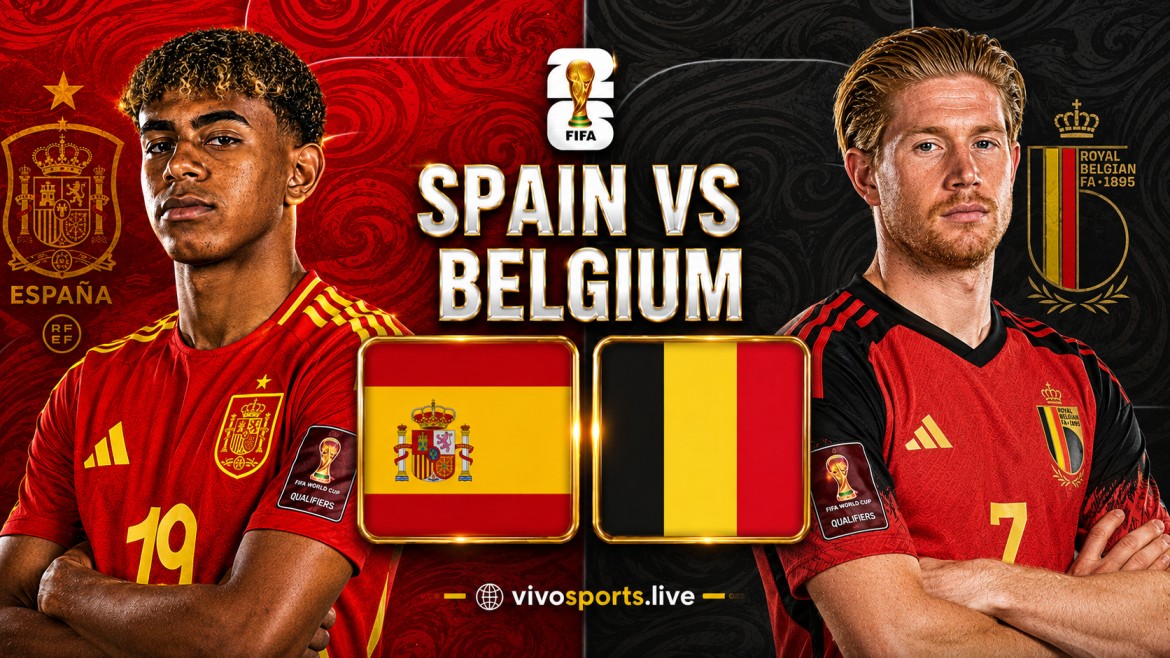
| Spain vs Belgium | |
| Match Details | |
| Match: | Spain vs Belgium |
| Tournament: | FIFA World Cup |
| Match Time: | 12:30 AM |
| Stadium: | SoFi Stadium, Inglewood, California |
Preview: Spain vs Belgium
Spain and Belgium are set to collide in one of the standout fixtures of the 2026 FIFA World Cup quarter-finals, with both European heavyweights aiming to secure a place in the last four. Spain have once again lived up to their reputation as one of the tournament's most technically gifted sides, progressing through the knockout rounds with composed and dominant performances. Belgium, meanwhile, have showcased their own blend of experience and youthful talent, overcoming difficult opponents through clinical finishing and disciplined defending. With a semi-final berth at stake, this encounter promises to be a fascinating tactical battle between two teams packed with world-class quality and capable of producing moments of brilliance at any stage of the match.
SPONSORED
Spain are expected to rely on their trademark possession-based philosophy, patiently controlling the tempo through Rodri and Pedri while constantly searching for openings in Belgium's defensive shape. The emergence of Lamine Yamal has added another dimension to Spain's attack, with the young winger combining pace, creativity and fearless dribbling to trouble defenders throughout the tournament. Belgium, however, possess plenty of attacking firepower of their own. Kevin De Bruyne remains the creative heartbeat of the Red Devils, while Jeremy Doku's explosive pace and Loïs Openda's movement make Belgium a constant threat on the counter-attack. The midfield battle between Rodri and De Bruyne could prove decisive, with whichever side gains control in the centre of the pitch likely to dictate the outcome of this high-quality contest.
Head-to-Head
Spain and Belgium have shared a competitive rivalry across international football for decades, producing several memorable encounters in both competitive tournaments and friendly matches. Historically, Spain have enjoyed the stronger record, thanks largely to their dominance during the late 2000s and early 2010s when they won both the FIFA World Cup and consecutive UEFA European Championships. Belgium, however, have significantly closed the gap in recent years with the emergence of their "golden generation," making every meeting between the two nations increasingly competitive. Their previous encounters have often been decided by fine margins, with both sides capable of dominating possession and creating numerous scoring opportunities. As two of Europe's footballing powerhouses, another closely fought contest is widely expected.
Spain Team Analysis
Spain's blueprint for success has been built on suffocating possession and a historically great defensive block. Manager Luis de la Fuente has his team playing with extreme tactical discipline, frustrating opponents while waiting for moments of magic from young prodigies and experienced midfielders. Their recent 1-0 victory over Portugal, secured by a late Mikel Merino goal, highlighted their ability to grind out results in high-pressure situations.
Belgium Team Analysis
After drawing their first two matches, Belgium’s attack has exploded. They are currently the most dangerous offensive team in the tournament, utilizing a balanced attack that doesn't solely rely on one player. With veterans pulling the strings and an incredible impact from their bench (five goals from substitutes so far), Belgium's relentless forward momentum makes them a threat for the full 90 minutes.
Tournament Performance
Spain have been among the most impressive teams of the tournament, comfortably advancing through the group stage before eliminating Portugal in a thrilling Round of 16 clash. Luis de la Fuente's side have combined defensive solidity with attractive attacking football, scoring freely while conceding very few goals. Rodri has controlled matches from midfield, Pedri has dictated the rhythm, and Lamine Yamal has emerged as one of the tournament's brightest young stars. Belgium have also enjoyed an excellent World Cup campaign, progressing confidently through the group stage before defeating the United States in the Round of 16. Kevin De Bruyne has continued to inspire the Red Devils with his creativity, while Jérémy Doku and Loïs Openda have consistently troubled opposition defences. Both teams enter this quarter-final in outstanding form, setting the stage for one of the most anticipated matches of the competition.
Spain Possible XI
Spain Predicted Lineup (4-3-3): Unai Simón; Marcos Llorente, Pau Cubarsí, Aymeric Laporte, Marc Cucurella; Mikel Merino, Rodri, Pedri; Lamine Yamal, Mikel Oyarzabal, Nico Williams.
Spain are expected to continue with their fluid 4-3-3 formation, with Rodri anchoring the midfield and Pedri dictating play. Yamal and Nico Williams will provide pace and creativity from the flanks, while Oyarzabal leads the attack.
Belgium Possible XI
Belgium Predicted Lineup (4-2-3-1): Koen Casteels; Timothy Castagne, Wout Faes, Zeno Debast, Maxim De Cuyper; Amadou Onana, Youri Tielemans; Jérémy Doku, Kevin De Bruyne, Leandro Trossard; Loïs Openda.
Belgium are likely to stick with their balanced 4-2-3-1 system, with De Bruyne orchestrating attacks behind Openda. Doku and Trossard will stretch Spain's defence, while Onana and Tielemans provide the stability needed to compete in midfield.
Match Prediction
This Quarterfinal is exceptionally difficult to call. Spain has the defensive solidity and possession control to completely neutralize the game, forcing Belgium to chase the ball. However, Belgium's aggressive high press and sheer volume of recent goals suggest they might be the team to finally breach the Spanish wall. If Spain can weather the early storm and maintain their shape, their technical superiority might just edge it out in a low-scoring affair. Expect a tense, dramatic cinematic finish in Hollywood.
| -----------.-------Broadcast Details-----.---.--------- | |
FIFA World Cup 2026: A New Era in Global Football
The FIFA World Cup is the most prestigious and widely watched sporting event in the world. Since its inception in 1930, the tournament has brought together nations from every continent, creating unforgettable moments of sporting excellence, national pride, and cultural unity. As football fans around the globe eagerly anticipate the FIFA World Cup 2026, the upcoming tournament promises to be one of the most historic editions ever held. With an expanded format, three host nations, and record participation, the 2026 World Cup marks a significant milestone in the evolution of international football.
The history of the FIFA World Cup began in 1930 when the first tournament was organized in Uruguay. Only 13 teams participated, and Uruguay emerged as the inaugural champion. Over the decades, the competition grew rapidly in popularity and size. Legendary teams such as Brazil, Germany, Italy, Argentina, and France have dominated different eras of World Cup history. Brazil remains the most successful nation with five World Cup titles, while other football powerhouses have consistently contributed to the tournament's rich legacy.
Several World Cups stand out as defining moments in football history. The 1958 tournament introduced the world to a young Pelé, who helped Brazil win its first title. The 1970 World Cup showcased one of the greatest teams ever assembled, led by Pelé and featuring an exciting style of football that captivated audiences worldwide. The 1986 tournament in Mexico became famous for Diego Maradona's brilliance, including the iconic "Hand of God" goal and his extraordinary solo effort against England. More recently, the 2010 World Cup in South Africa became the first World Cup hosted on African soil, highlighting football's truly global reach.
The most recent edition before 2026 was the 2022 FIFA World Cup in Qatar. It was the first World Cup held in the Middle East and the first played during November and December due to extreme summer temperatures. The tournament delivered one of the greatest finals in football history, as Argentina defeated France in a dramatic penalty shootout. Lionel Messi finally achieved his dream of winning the World Cup, cementing his place among the greatest footballers of all time. The tournament demonstrated the growing competitiveness of international football, with teams from different regions performing strongly.
The FIFA World Cup 2026 represents a major transformation in the tournament's structure. For the first time, 48 teams will participate instead of the traditional 32-team format used since 1998. This expansion aims to provide more nations with the opportunity to compete on football's biggest stage. The tournament will feature 12 groups of four teams each, with the top two teams from every group and the eight best third-placed teams advancing to the knockout rounds. As a result, the competition will include a record 104 matches, making it the largest World Cup in history.
Another historic aspect of the 2026 World Cup is its hosting arrangement. For the first time ever, three countries will jointly host the tournament: the United States, Canada, and Mexico. Matches will be played across 16 host cities spread throughout North America. Mexico will make history by becoming the first country to host World Cup matches in three different editions, having previously hosted the tournament in 1970 and 1986. The United States, which successfully hosted the 1994 World Cup, is expected to stage the majority of the matches, while Canada will host World Cup games for the first time.
The tournament is scheduled to take place from June 11 to July 19, 2026. Millions of fans are expected to travel across North America, while billions more will follow the matches through television broadcasts and digital platforms. FIFA estimates that this edition will attract unprecedented global attention due to its expanded format and wider geographic reach.
One of the most exciting features of the expanded tournament is the increased representation from different continents. More qualification spots have been allocated to Asia, Africa, and other regions, allowing emerging football nations a greater chance to participate. This change is expected to promote football development worldwide and create opportunities for new teams to make their mark on the global stage. The inclusion of more nations reflects FIFA's goal of making football more inclusive and globally representative.
The 2026 World Cup will also showcase advancements in technology and sports management. Modern stadiums, improved fan experiences, enhanced broadcasting technologies, and the continued use of Video Assistant Referee (VAR) systems are expected to improve fairness and entertainment. Organizers are preparing extensive transportation, security, and infrastructure plans to accommodate the massive scale of the tournament. Given the event's size, cooperation among the three host nations will be essential to ensuring its success.
From a sporting perspective, the tournament is expected to feature many of the world's best players. Established football powers such as Argentina, Brazil, France, Germany, England, and Spain will likely be among the favorites. At the same time, emerging nations could surprise fans with strong performances, continuing the World Cup tradition of unexpected success stories. Young stars who have risen through domestic and international competitions will have the opportunity to become household names on football's grandest stage.
Beyond football, the World Cup serves as a powerful symbol of international unity. People from different cultures, languages, and backgrounds come together to celebrate their shared passion for the sport. The tournament promotes friendship, tourism, economic growth, and cultural exchange. Throughout history, the World Cup has demonstrated sport's ability to bridge differences and create lasting memories for fans worldwide.
In conclusion, the FIFA World Cup 2026 promises to be a landmark event in the history of football. Building upon nearly a century of tradition, the tournament will introduce an expanded format, unprecedented international cooperation, and broader global participation. As fans look forward to the excitement, drama, and unforgettable moments that define every World Cup, the 2026 edition stands ready to open a new chapter in the beautiful game's remarkable story. It will not only celebrate football excellence but also reinforce the values of unity, diversity, and global friendship that make the FIFA World Cup one of humanity's most cherished sporting events.
Attention
Vivosports Doesn't host any media content on its own Site-Our site visitors might use external or third parties services to show content, (Example: Embedding media from sites like Bet365, Dailymotion, Streamable, etc ..) We Notify all copyright owners, to discover that the links and media shared by visitors and contained within this site are hosted somewhere else on the web or embedded from other various sites like above. If you have any legal issues please contact appropriate media file owners/hosters. All trademarks, videos, trade names, service marks, copyrighted work, and logos herein belong to their respective owners/companies. Vivosports is not responsible for what other people upload to 3rd party sites.
